In May 2002, during a severe drought in Rajasthan's Barmer desert, a PhD student walked onto a government relief work site and watched villagers break dry earth by hand, fill metal head-baskets called tagaris, and heap the dirt nearby. To an urban observer it looked like the classic newspaper caricature of rural make-work, digging holes and filling them up. When she came back a year later after the monsoon, that scraped depression had turned into a vast pond supplying water to the village and its livestock.
That student was Reetika Khera. Today she is a professor of economics at the Indian Institute of Technology Delhi (IIT Delhi), one of India's flagship publicly funded engineering universities, roughly the Indian equivalent of MIT or Caltech. Most people know IIT Delhi for training engineers and computer scientists, though like MIT it also runs a Department of Humanities and Social Sciences where students take elective courses in economics and public policy alongside their technical degrees (before IIT Delhi, Khera taught at IIM Ahmedabad, India's top business school). Over the last twenty years she built a serious career running rural household surveys across fourteen states, documenting how broken state grain-ration shops were cleaned up, and warning early when mandatory biometric checks (Aadhaar) locked poor families out of food rations, warnings later corroborated in part by randomized trials in Jharkhand.
That history deserves credit. Her 2002 to 2013 fieldwork mattered in an India where roughly half of subsidised grain leaked out of the system and digital transfer rails did not exist. The trouble starts when she turns those IIT Delhi and IIM Ahmedabad classroom discussions into a 2026 primer called Freebies or Rights: Understanding Social Policy in India (published by Speaking Tiger Books, translated from her 2025 Hindi book Revdi Ya Haq), aimed at persuading sceptical readers to look at India's welfare architecture through a "sympathetic" lens.
I read Part 1 of the book (pages 1 to 23, covering the table of contents, Table 1.1, and Chapter 1; I have not audited Chapters 2 to 13 or the statistical appendix because they were not in this excerpt). If an IIT economics professor is going to argue that critics of India's welfare system simply misunderstand the facts, the opening chapter needs to hold up when you check its primary sources. It does not, and the reason those factual slips appear turns out to be the exact same reason the economic model behind the book breaks down.
the slips in chapter 1
Start with page 19, where Khera counters former Rajasthan Chief Minister Vasundhara Raje's 2014 criticism of NREGA (India's National Rural Employment Guarantee Act of 2005, which guarantees rural households up to 100 days a year of unskilled manual work at minimum wages). To show how out of step Raje was, Khera writes that "around the same time, the World Development Report 2014 was projecting the NREGA as 'a stellar example of rural development'."
If you actually pull the 363-page official text of the World Bank's World Development Report 2014: Risk and Opportunity (about 1.47 million characters, even after rejoining hyphenated line breaks), the word stellar appears zero times, and the phrase rural development appears zero times. That exact quote came from an October 10, 2013 Economic Times article attributing it to the report, which is an awkward catch in a chapter that starts on page 8 by warning readers not to trust newspaper commentary on public works. What makes it stranger is that page 155 of the real World Development Report 2014 actually does speak positively about NREGA's rights-based design and cites Rajasthan's relatively strong performance (84% of job seekers getting work, averaging 71 days). Look down at Endnote 57 for that paragraph, however, and the World Bank's two sources are Dreze and Khera (2011), her own co-edited book, alongside Liu and Barrett (2013). On the very same page, the report warns that no Indian state manages to offer workers all the employment they demand (only 56% nationwide, averaging 37 days), and the only other two places the report mentions NREGA (pages 30 and 202) praise electronic bank-account payments, the exact kind of digital payment reform Khera criticises two pages earlier on page 17.
That same lack of primary verification shows up in Table 1.1 on page 13, the centerpiece chart mapping India's welfare schemes to the Constitution. The entire thesis of the chapter rests on the legal line between discretionary political favours and enforceable constitutional rights, yet the table gets the Constitution wrong twice. For early-childhood centres (ICDS, locally called Anganwadis) and school Mid-Day Meals, Table 1.1 cites Article 39a and quotes "children are given opportunities and facilities to develop in a healthy manner.." In the Constitution of India, that clause is Article 39(f). Article 39(a) is the right to an adequate means of livelihood, which she quotes one line above as plain Article 39, and Article 39A is equal justice and free legal aid. Right next to it, Table 1.1 places Article 21A / 86th Amendment to the Constitution 2002 inside the row labelled Directive Principles. In India's Constitution, Part IV Directive Principles are non-binding policy goals, while Part III Fundamental Rights are enforceable in court. Article 21A (the Right to Education) is a Part III Fundamental Right, something Khera's own prose gets right on page 14, and Article 45, the actual Directive Principle rewritten in 2002 to cover early childhood care for children under six, is missing from the table altogether.
Recent dates and laws slip the same way. The Hindi title of her book, Revdi Ya Haq, borrows the north Indian sweet revdi that became political shorthand for electoral "freebies" after Prime Minister Narendra Modi used it in a major speech. Page 15 dates that remark to "a political speech in 2024" with no citation, even though Modi's landmark "revdi culture" speech was delivered two years earlier, on 16 July 2022, at the Bundelkhand Expressway inauguration. Table 1.1's footnote also garbles the December 2025 statute that replaced MGNREGA as VB-GRAMGA instead of the enacted Viksit Bharat - Guarantee for Rozgar and Ajeevika Mission (Gramin) Act, 2025 (VB-G RAM G Act, 2025), and page 20 drops it in one sentence right after an unimplemented 2014 proposal to shrink NREGA, mentioning neither its 125-day provision nor the structural shift economists actually debate (60:40 Centre-state cost-sharing, a 60-day peak-season pause, and Centre-set normative allocations that leave states paying any excess).
Even the chapter's broad historical arc leaves out uncomfortable facts from the decade it covers. Chapter 1 divides 2004 to 2024 into a "rights-based" decade under the UPA government (2004 to 2014) and a "push-back" decade under the NDA government (2014 to 2024), spending nearly two pages on three 2014 Rajasthan episodes under Chief Minister Vasundhara Raje. Along the way it leaves out three major counter-trends from that same window. Public health spending is indeed still low at 1.43% of GDP in the 2022-23 National Health Accounts (after a one-off 1.84% COVID spike in 2021-22), yet inside that same 2022-23 NHA release, the government's share of total health spending rose from 28.6% to 43.7% between 2013-14 and 2022-23, while out-of-pocket spending fell from 64.2% to 43.4%. On food rations (the Public Distribution System, or PDS, codified in the 2013 National Food Security Act, NFSA), freezing coverage to the 2011 Census and leaving over 10 crore eligible people out is a genuine failure, yet statutory NFSA grain (which cost ₹1 to ₹3 per kg before COVID) was cut to free (₹0/kg) for roughly 81 crore beneficiaries from January 2023 through 2028, which goes unmentioned. And on page 17, calling India a social-security "laggard" without giving a metric ignores that the ILO's 2025 update puts India's cash-benefit headcount coverage at 64.3%, above the 52.4% world average, even though benefit adequacy remains low and the ILO notes much of the jump reflects wider data capture of state schemes.
If these were just editing slips, a publisher could fix them in the second printing and the book's argument would still stand. They matter because they point to a deeper habit: arguing backwards from a worldview cemented in May 2002. And the fastest way to see how that worldview breaks is to go right back to the Barmer pond on page 7.
the barmer pond problem
When Khera looks back at the villagers digging that desert pond by hand with head-baskets, and later defends NREGA's 40% ceiling on materials and its legal ban on contractors and labour-displacing machinery on page 20, she treats the full pond after the monsoon as proof that the design works. It proves nothing of the sort. The monsoon proved that the pond was useful. It never proved that making hungry human beings dig earth by hand in May desert heat while banning excavators is an economically sensible way to build a pond or to transfer cash.
In public finance, two Nobel-winning ideas explain why. The Diamond-Mirrlees Production Efficiency Theorem (1971) proved that even if your sole goal is maximum redistribution to the poor, you should stay on the technological frontier when producing goods and assets (use modern machinery and engineering to dig the pond) and handle redistribution through transfers. Stepping deliberately inside the production frontier by banning machines burns real resources. Jan Tinbergen's Rule says the same thing from a policy-design angle: one instrument cannot efficiently hit three independent targets at once. NREGA forces a single instrument, manual village earthwork, to chase income insurance, rural infrastructure, and rural wage bargaining at the same time.
There is exactly one setting where hand-basket workfare makes economic sense: an acute drought or famine, when local labour markets freeze, the opportunity cost of idle rural labour drops close to zero, and the state has no way to target relief. That was the exact logic of the 1880 Indian Famine Codes, and it describes Barmer in May 2002. The mistake Khera's framework makes is taking an emergency famine-relief instrument from the 1880s and turning it into India's permanent, normal-year welfare architecture in 2026.
The moment you leave an acute drought and enter a normal year, people actually have other productive uses for their time, so making them stand at a worksite to qualify for a transfer carries heavy hidden costs. In a landmark World Bank study of Bihar (where rural poverty was 55% and rural unemployment 18%, the most favourable possible setting for workfare), Murgai, Ravallion, and van de Walle (2016) measured what NREGA workers gave up to participate. On average they gave up roughly one-third of the workfare wage in forgone earnings (42 to 51% of gross employment for men, 31 to 36% for women). Once those forgone earnings and non-wage costs were counted, for the same public budget, MGNREGA reduced poverty less than a completely untargeted universal basic income handed blindly to every citizen (and less than uniform transfers on poverty-line cards).
And because you can only collect that wage by physically showing up at a village worksite, two further side effects kick in automatically. First, using data on roughly 2.5 million rural Indian children, Shah and Steinberg (2021) in the Journal of Human Resources exploited the staggered rollout of NREGS and found that each year of exposure reduced school enrollment among teenagers aged 13 to 16 by 1 to 3.5 percentage points, lowered math scores by 2% of a standard deviation per year, and raised adolescent labour by 4 percentage points as boys stepped into market work and girls into unpaid domestic work when parents joined NREGA. Notably, children aged 0 to 4 benefited later in life from the early household income (and to keep the literature honest, Afridi et al., 2016 found gains when mothers worked, while Atkin, 2016 in the AER showed new Mexican export factories also raised teen dropout via higher local wages, showing why secondary stipends matter alongside any income boost). Second, structural gravity estimates by Imbert and Papp (2020) in the JEEA found that NREGA cut short-term seasonal rural-to-urban migration by 22% in implementing districts, while pushing 5% more migration into non-program districts and raising urban wages by up to 4.1% under full rollout.
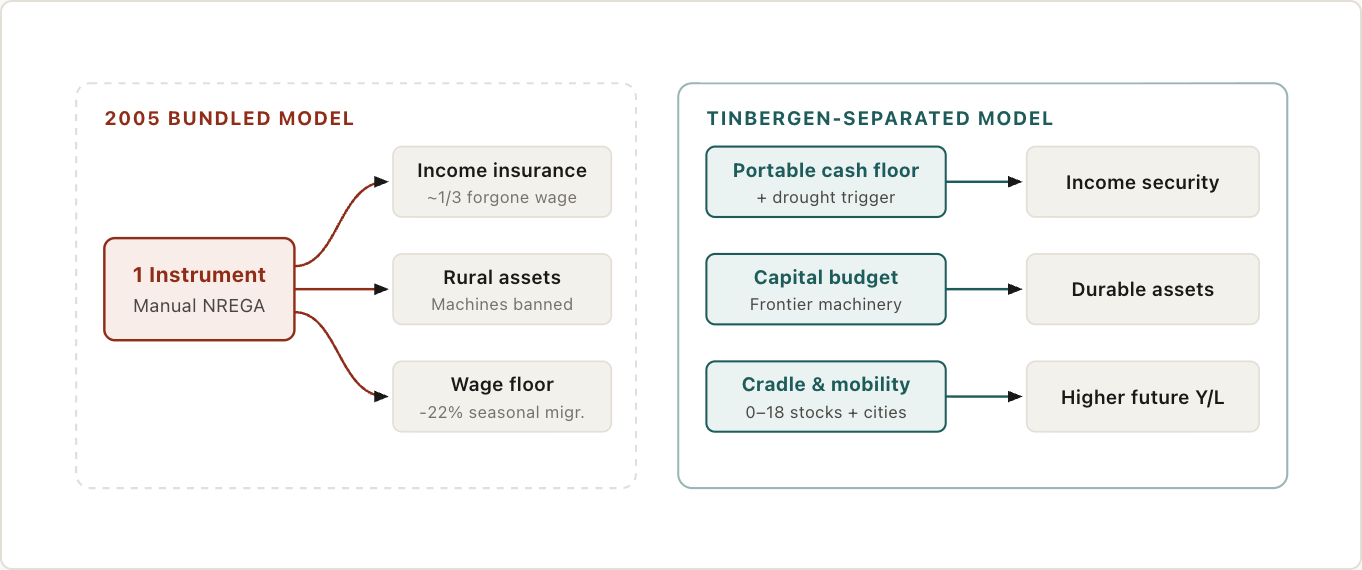
There is an obvious irony in watching an opening parable from an Indian Institute of Technology celebrate state-mandated hand-basket digging over excavators. The entire point of technology is to eliminate back-breaking manual drudgery and multiply what an hour of human work produces. Treating an 1880s famine ordeal as permanent modern social policy does the exact opposite, and as soon as you trace that 22% drop in seasonal migration, it connects straight to India's biggest structural failure.
buying with flows what east asia built with stocks
In India, moving from low-productivity village agriculture into higher-productivity city work is already unusually hard. Munshi and Rosenzweig (2016) showed in the American Economic Review that rural caste networks suppress migration precisely because informal caste insurance is tied to staying in the village; leave your village and you lose your safety net. Public insurance only frees workers to migrate when it travels with the citizen (portable cash, nationally portable rations under One Nation One Ration Card, and urban housing). Tying an employment guarantee to a worker's home village stacks a second place-bound anchor right on top of the village network.
Defenders of India's rural safety net often push back by pointing to East Asia, arguing that South Korea, Taiwan, and China built welfare early too, or that China's village land rights safely cushioned migrant workers. That comparison collapses as soon as you separate productive stocks from consumption flows.
What South Korea, Taiwan, and post-1978 China actually built before or during industrialisation were productive stocks: land reform, universal primary schools, basic sanitation, and vaccines, paired immediately with export-disciplined, labour-intensive manufacturing that pulled rural workers into formal factory jobs. They did not build a 67%-population grain procurement monopoly, permanent rural manual-earthwork guarantees, or state-run urban canteens at $2,500 per capita. South Korea did not introduce a National Pension until 1988, after a quarter-century of rapid industrial growth.
China's own empirical record cuts directly against place-bound rural subsidies. Ngai, Pissarides, and Wang (2019) in the JEEA proved that China's non-tradable village land rights and local hukou social subsidies were "the more important barrier to industrialization," generating 18 to 22% over-employment in agriculture and still explaining roughly a quarter of China's urban-rural productivity gap in 2010, with an additional 7% coming from local social subsidies tied to place of registration. When China loosened those internal mobility barriers between 2000 and 2005, Tombe and Zhu (2019) in the American Economic Review showed that falling internal migration and trade costs accounted for 36% of China's entire aggregate labour-productivity growth, more than external WTO trade liberalisation.
Put East Asia next to India and the real dividing line comes into focus. The debate was never pro-poor versus anti-poor. India is trying to buy with endless subsistence flows what East Asia bought with productive stocks, and then mistaking the compensation bill for development.
You can see that imbalance right inside Khera's own Table of Contents (page 10). Health and basic education are not even among the seven core schemes the book profiles; they are compressed into one chapter on COVID-19 (Chapter 10). Five of the seven flagship pillars, PDS grain, NREGA earthwork, old-age and widow pensions (NSAP), maternity cash, and urban canteens, are consumption flows. Even India's ₹2.03 lakh crore annual Union food subsidy (FY 2025-26, PRS India) runs largely as a 1960s-era grain procurement and storage machine through the Food Corporation of India (FCI), where the government's own Shanta Kumar Committee (2015) found that only about 6% of Indian farmers sell grain to state agencies at the Minimum Support Price (MSP).
what happens when a real budget enters the room
If public money were free, you could fund both productive stocks and open-ended adult consumption flows at the same time. Chapter 1 writes almost as if money were free, quoting British sociologist Richard Titmuss (1968) on page 15 to list five moral reasons why welfare is not a burden, with zero discussion of opportunity cost or trade-offs across schemes. Yet India's combined Centre-plus-State tax-to-GDP ratio sits around 18%, and interest payments alone eat 25% of total Union expenditure and 37% of Union revenue receipts (PRS India, FY 2025-26). When Britain built the National Health Service in 1948, the European welfare state Khera points to as an aspiration on pages 11 and 23, UK tax revenue was already 34.3% of national income (Hansard).
Once you put a finite 18% tax base around Table 1.1, calling every scheme from cradle to grave an equal "right" removes the one tool any serious economist needs: a rule for ranking where the next rupee goes. Modern public economics uses the Marginal Value of Public Funds (MVPF), formalised by Hendren and Sprung-Keyser (2020) in the Quarterly Journal of Economics. Across hundreds of policy evaluations, investments in early childhood (maternal nutrition, vaccines, early health, and foundational schooling from ages 0 to 18) produce near-infinite returns because they compound into lifetime earnings and future tax revenues. Adult in-kind food subsidies and manual workfare with forgone private wages routinely score at or below 1. Inside a tight budget, expanding adult consumption flows directly crowds out the cradle investments that actually change a child's future.
Even where India did pass a statutory right specifically for children, the Right to Education Act of 2009 (RTE), the same legalistic blind spot appears. Statutory rights work reasonably well for things bureaucrats can easily count, like bags of wheat or names on an enrollment register. They fail on high-discretion services like classroom teaching and clinical care, a pattern Lant Pritchett calls the "flailing state" and economists call Goodhart's Law. RTE mandated input rules (buildings, teacher qualifications, pupil-teacher ratios), delivered near-universal enrollment, and left actual learning outcomes dismal, which Khera acknowledges on page 14.
Yet Chapter 1 blames "over-reliance on the private sector" (page 10) without asking why roughly half of Indian schoolchildren, including millions of poor rural parents paying out of pocket, have already walked out of free government schools. In Andhra Pradesh, Muralidharan and Sundararaman (2015) ran a two-stage randomised school-voucher experiment published in the QJE and found that voucher private schools did not simply pay lower teacher wages. They matched public-school test scores in Telugu and Math while spending 40% less instructional time on Telugu and 32% less time on Math, used the freed hours to teach Hindi (where lottery winners posted large gains in a subject public schools did not teach at all), Science (+100 minutes a week), English (+90), Social Studies (+65), and Computers (+45), and did all of it at less than one-third the cost per student.
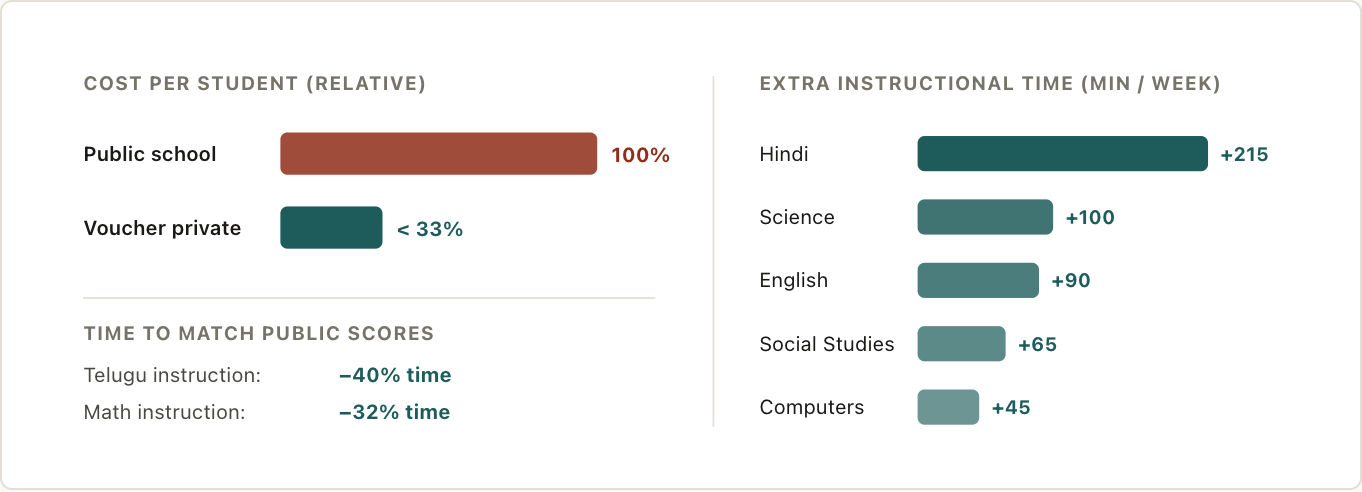
In government-procured monopolies where captive users have nowhere else to go (Hart, Shleifer, and Vishny, 1997), private contractors often cut quality to save money. School choice breaks that trap because parents can observe teacher attendance and basic effort and walk away from bad schools, forcing accountability that RTE's statutory input rules never produced.
why legal floors do not stop freebies
At this point, a defender of Khera's framework usually falls back on politics rather than efficiency: even if statutory entitlements are imperfect, putting welfare into law stops Mai-Baap sarkar (patronage politics where citizens depend on a leader's goodwill) and kills the "freebies" attack.
Read Chapter 1 carefully and you see that this defense breaks too. On page 15, Khera says the boundary between legitimate welfare and freebies is "ultimately a political debate" while adding that "sound economic principles" can help draw it, yet Chapter 1 never states what those principles are. Meanwhile, an RBI Bulletin staff article (2022) already distinguishes public merit goods (PDS, employment guarantee, education, health) from non-merit freebies, and the RBI's December 2024 State Finances report warns that rising outlays on farm loan waivers, free utilities, and pre-election cash transfers to farmers, youth, and women risk crowding out productive capital spending.
What Chapter 1 misses is why India's freebie auction exploded after Parliament passed NREGA, RTE, and NFSA. In political science (David Mayhew's credit-claiming principle), once a statutory floor is baked into voters' baseline expectations, no state politician wins fresh electoral credit for maintaining it. So rival parties across the ideological spectrum stack branded, discretionary giveaways on top: free electricity, loan waivers, and ₹1,500 to ₹2,500 monthly cash transfers. Statutory floors do not stop revdi politics; they become the baseline ratchet underneath it. Even Tamil Nadu, India's strongest industrial state with genuinely capable welfare delivery, now runs a persistent revenue deficit, carries debt-to-GSDP of 26.1 to 28.3% (above Gujarat's 17.6%, Maharashtra's 19.7%, and Karnataka's 23.4%), and holds ₹2.47 lakh crore in power-utility (TANGEDCO) liabilities driven heavily by non-merit power subsidies.
the 2045 wall and why iit delhi matters
Follow every thread above to its logical endpoint and you hit Nicholas Barr's single iron rule of public finance: a statutory right is not wealth; it is a legal claim on future real output per worker (Y/L).
India enters 2026 inside a narrowing twenty-year demographic window. By mid-century, roughly one in five Indians will be over age sixty, right as artificial intelligence, robotics, and automation squeeze the old labour-intensive export-manufacturing ladder that lifted East Asia. At the same time, the workers who will have to generate the output that pays for India's 2045 healthcare and pensions are being born right now, in a country where roughly 35% of young children remain stunted.
Put those two facts side by side and the fake fight between growth and welfare collapses into one equation. If you genuinely care about universal healthcare and dignified old-age pensions in 2045, multiplying real output per worker right now through semiconductors, frontier manufacturing, AI infrastructure, reliable energy grids, tradable land markets, and dense cities is non-negotiable. Without that jump in productivity, India gets old before it gets rich, and statutory rights default quietly through inflation, the exact way India's central ₹200 old-age pension eroded after 2007. Conversely, if you genuinely care about multiplying output per worker by 2045, fixing early-childhood nutrition, maternal health, and actual classroom learning right now is non-negotiable, because stunted, under-educated children cannot run chip fabs or AI ecosystems twenty years from now.
That brings the whole story back to IIT Delhi. To be completely fair, IIT Delhi's Humanities and Social Sciences department does not ban market or frontier economics; its catalogue includes Game Theory, Theory of Market Design, Industrial Economics, International Trade, Advanced Growth Theory, and Machine Learning for Computational Finance alongside social-policy electives, and professors everywhere have academic freedom to argue strong views. The problem is not that social policy is taught at an IIT. The problem is standards and ambition. When a book born out of IIT Delhi and IIM Ahmedabad classrooms enters public debate in 2026 with avoidable citation, constitutional, and date errors in Chapter 1, while spending its conceptual energy defending 2005 to 2013 machine-banning subsistence machinery as the rest of the world compounds compute, energy, and industrial productivity, our best technological institutions are fighting the last war.
keeping the floor while replacing the machinery
None of this is an argument for abolishing social protection. With a large informal workforce and an ageing demographic curve ahead, a tax-financed floor for citizens is both humane and economically necessary. What breaks under evidence is not the goal of a floor, it is the 2005 to 2013 machinery built to deliver it.
| 2005 to 2013 instrument | Why it breaks for 2026 to 2045 | Rebuilt design |
|---|---|---|
| Place-bound manual NREGA (machines banned, 40% material cap) | Violates Tinbergen's Rule; loses to untargeted cash in Bihar (Murgai et al. 2016); pulls 13-16s from school (Shah & Steinberg 2021); cuts seasonal migration 22% (Imbert & Papp 2020) | Separate the jobs: portable cash floor in normal years, capital-budget frontier machinery for rural assets, manual workfare strictly as an automatic drought or disaster trigger |
| FCI-procurement PDS (frozen at 2011 Census) | Heavily a 1960s producer and storage bill (~6% of farmers sell at MSP, Shanta Kumar 2015); excludes over 10 crore eligible people under stale 2011 quotas | Update coverage dynamically, shrink FCI procurement to strategic buffer stocks, and give households portable cash-or-grain choice nationally (ONORC) |
| RTE input-mandated schooling | Goodhart's Law: high enrollment, dismal learning; input rules lock out lower-cost models while parents exit to private schools delivering higher productivity at under one-third the cost (Muralidharan & Sundararaman 2015) | Shift from input mandates to measured learning accountability, public school report cards, and per-child funding that follows the student |
| Unranked cradle-to-grave claims plus discretionary cash auctions | Adult consumption flows crowd out infinite-MVPF early childhood stocks; statutory baselines invite election-eve top-ups (RBI Dec 2024) | Child-first priority rule (first 1,000 days, nutrition, foundational literacy), price-indexed universal old-age and disability floor, independent fiscal costing and hard rules against election-eve giveaways |
| Separate survival track "for the informal sector" | Manages poverty inside informality rather than multiplying output per worker before India ages | Single universal citizen floor paired with factor-market and frontier-growth reforms: tradable land tenure, urban housing, power and labour reform, manufacturing, energy, and AI competitiveness |
Reetika Khera's 2002 to 2013 fieldwork mattered for an India of 50% ration leakage and zero digital rails. The flaw in Freebies or Rights is treating that 2002 Famine-Code toolkit as India's permanent horizon while letting basic citation, constitutional, and date errors slip into Chapter 1. India does not have to choose between abandoning the poor and romanticising head-baskets. It needs to fund early-childhood stocks first, keep basic income insurance portable and fiscally disciplined, build infrastructure with modern machines instead of banning them, and point its best technological minds toward multiplying what India produces per worker before 2045 arrives.
sources
- Khera, Reetika (2026). Freebies or Rights: Understanding Social Policy in India, Part 1 (pp. 1-23, Table 1.1). Speaking Tiger Books (English translation of Revdi Ya Haq, Rajkamal Prakashan, 2025).
- World Bank (2013). World Development Report 2014: Risk and Opportunity: Managing Risk for Development (full 363-page text, pp. 30, 155, 202, Endnote 57 citing Dreze & Khera 2011 and Liu & Barrett 2013).
- Constitution of India: Article 21A (Part III, Fundamental Rights, 86th Amendment 2002), Article 39(a), Article 39(f), Article 39A (42nd Amendment), and Article 45 (Part IV, Directive Principles).
- Press Information Bureau (PIB): PM's Bundelkhand Expressway address, 16 July 2022; VB-G RAM G Act, 2025 commencement notices (Dec 2025 / May 2026); National Health Accounts Estimates 2022-23 (PRID 2265816); NSAP State top-ups (PRID 2152593); ILOSTAT India 64.3% social-protection update (PRID 2135592 & ILO result note).
- Reserve Bank of India (RBI): State Finances: A Risk Analysis, RBI Bulletin staff article (June 2022); State Finances: A Study of Budgets of 2024-25 (December 2024).
- PRS Legislative Research: Union Budget 2025-26 Analysis; Demand for Grants 2025-26: Food & Public Distribution; Tamil Nadu Budget Analysis 2025-26; Summary of VB-G RAM G Bill, 2025.
- Murgai, R., Ravallion, M., & van de Walle, D. (2016). "Is Workfare Cost-Effective Against Poverty in a Poor Labor-Surplus Economy?" World Bank Economic Review / World Bank WPS 6673.
- Shah, M., & Steinberg, B. M. (2021). "Workfare and Human Capital Investment: Evidence from India." Journal of Human Resources, 56(2) / NBER WP 21543. (Alongside Afridi, Mukhopadhyay & Sahoo, 2016; Atkin, 2016, AER.)
- Imbert, C., & Papp, J. (2020). "Short-Term Migration, Rural Public Works, and Urban Labor Markets: Evidence from India." Journal of the European Economic Association, 18(2): 927-965.
- Ngai, L. R., Pissarides, C. A., & Wang, J. (2019). "China's Mobility Barriers and Employment Allocations." Journal of the European Economic Association, 17(5): 1617-1653.
- Tombe, T., & Zhu, X. (2019). "Trade, Migration, and Productivity: A Quantitative Analysis of China." American Economic Review, 109(5): 1843-1872.
- Muralidharan, K., & Sundararaman, V. (2015). "The Aggregate Effect of School Choice: Evidence from a Two-Stage Experiment in India." Quarterly Journal of Economics, 130(3): 1011-1066.
- Hendren, N., & Sprung-Keyser, B. (2020). "A Unified Welfare Analysis of Government Policies." Quarterly Journal of Economics, 135(3): 1209-1318.
- Munshi, K., & Rosenzweig, M. (2016). "Networks and Misallocation: Insurance, Migration, and the Rural-Urban Wage Gap." American Economic Review, 106(1): 46-98.
- Diamond, P. A., & Mirrlees, J. A. (1971). "Optimal Taxation and Public Production I: Production Efficiency." American Economic Review, 61(1): 8-27.
- UK Parliament (Hansard, 22 Dec 1954): National Product and Tax Revenue (1948 UK tax revenue = 34.3% of national income). Shanta Kumar High-Level Committee Report (2015) on FCI restructuring. IIT Delhi HSS Programme Structure (
hss.iitd.ac.in/programme-structure).