So I was watching the Project Hail Mary movie and thought let me try to code the simulation and the fuel math from the book. Like actually write a program that calculates the relativistic fuel requirements for the Hail Mary's trip to Tau Ceti, because why not, the best way to understand the physics is to plug the numbers in and play. And that's when things got interesting. I ran the simulation and the ship just passed right by Tau Ceti. It didn't stop. I stared at the screen for a second like wait why didn't it stop?
The setup
Quick context if you haven't read it. In Project Hail Mary, there's this alien organism called Astrophage that's eating our sun. Earth is dying. Humanity's last hope is to send a ship to Tau Ceti, which is 11.9 light years away, because that's the one star that isn't affected.
Here's what Hail Mary gives us:
| What | Value |
|---|---|
| Distance | 11.9 light years |
| Acceleration | 1.5g |
| Ship mass | 100,000 kg |
| Fuel (Astrophage) | 2,000,000 kg |
| Mass ratio | 20:1 |
20:1 mass ratio. The Space Shuttle was about 16:1, so this is realistic. Andy Weir clearly did his homework, and the numbers look clean.
There are no brakes in space
That 2 million kg of Astrophage gets you to Tau Ceti at 99.5% the speed of light, which is insane. That's fast. But you blow past it. No stopping. You just zoom past the entire Tau Ceti system at almost light speed and keep going forever. That's not a mission, that's a flyby.
Think of it like this. You're driving on a highway at 200 km/h and your exit is coming up, but there are no brakes. No exit ramp. Nothing. You just keep going. Great speed, wrong destination.
Except in space it's way worse because there's literally no friction. Nothing slows you down, ever. Once you're going 99.5% c you're going 99.5% c until the end of time. So how do you actually stop?
You flip the entire ship
This is the part that broke me. In space the only way to slow down is to turn your entire ship around 180 degrees and fire the same engines in the opposite direction. Same fuel, same engine, just pointed backwards now. So you accelerate for the first half of the trip, then at the midpoint you flip the ship, and you burn for the second half to slow down.
Now most people think, ok so you need double the fuel right? No. You need to square the mass ratio. Why? Because the fuel you need to slow down is extra weight during the acceleration phase, so you need more fuel to accelerate that fuel, and then more fuel to accelerate that fuel. It compounds. It's fuel for fuel for fuel all the way down.
I made a quick Manim explainer for this exact moment because this is one of those ideas that clicks way faster when you see the mission profile move.
So instead of 20:1 you need:
20² = 416:1
Not 2 million kg. About 42 million kg of Astrophage. That's a lot more than what the book says. Play with this:
Why No Brakes Means More Fuel
Accelerate to about 99.5% c during the first half, then coast through the second half. You reach Tau Ceti fast, but you do not stop.
Ok but how does the crew survive a 12 light year trip?
Before I get to the fix let me explain something that still blows my mind. Time dilation. This isn't sci-fi, this is real measured confirmed physics.
Imagine the simplest clock possible. Two mirrors facing each other with a photon bouncing between them. Every bounce is one tick. If the clock is sitting still the photon goes straight up and down, simple. But if that clock is moving, the photon has to travel a diagonal path because the mirrors moved sideways while the photon was traveling. The path is longer.
The photon still moves at exactly c, not c plus the ship's speed, just c. Every single experiment ever done confirms this. Einstein's second postulate. Same speed, longer path, takes more time. The moving clock literally ticks slower. Drag the slider and see it yourself:
🔬 Time Dilation — The Light Clock
Same photon, same speed (c), but the moving clock's photon travels a longer diagonal path. Same speed + longer distance = more time per tick. The moving clock literally ticks slower.
At 99.5% c, for every 10 years on Earth only about 1 year passes on the ship. That's how a crew can survive an 11.9 light year trip in under 4 years, because time itself slows down for them.
But there's another thing happening that's even wilder. It's not just time that changes, space itself contracts. From the ship's perspective the 11.9 light year distance to Tau Ceti physically shrinks. At 99.5% c, the ship only "sees" about 1.19 light years of distance. The universe literally compresses in your direction of travel. Tau Ceti gets closer, not metaphorically, physically. Drag the slider and watch the planets come together:
Length Contraction
As speed increases, the distance between Earth and Tau Ceti physically contracts from the ship's frame of reference.
This is why the crew doesn't experience 12 years of travel. From their frame of reference they're crossing a much shorter distance. Time dilation and length contraction are two sides of the same coin, just Einstein's spacetime bending around you.
99.5% is basically the speed of light right? Just one more push?
This is what I thought too. We're so close, half a percent away, just push a little harder? Nope. This is one of the most beautiful traps in physics. Look at what each additional "9" costs you:
📈 The Wall — Why You Can Never Reach Light Speed
Each additional "9" costs roughly 3× the total energy of everything before it combined. The curve goes vertical. That's the wall.
| Speed | Gap to c | γ (energy multiplier) | Each 9 costs |
|---|---|---|---|
| 90% c | 10.0% | 2.3 | baseline |
| 99% c | 1.0% | 7.1 | ~3× more than all previous combined |
| 99.5% c ← Hail Mary | 0.5% | 10.0 | ~3× more than all previous combined |
| 99.9% c | 0.10% | 22.4 | ~3× more than all previous combined |
| 99.99% c | 0.010% | 70.7 | ~3× more than all previous combined |
| 99.999% c | 0.001% | 223.6 | ~3× more than all previous combined |
Hover over that curve and watch it go vertical. Going from 99.99% to 99.999% costs roughly 3x the total energy of everything it took to reach 99.99% in the first place. Each nine costs 3x more than all previous nines combined.
The speed of light isn't a wall you crash into. It's more like a horizon. The closer you get the further it moves, and you'd need literally infinite energy to close that last gap. That's not a limitation of our rockets or our technology, that's the actual geometry of spacetime.
But because of time dilation, if you just keep accelerating at 1.5g, you can reach Betelgeuse (500 ly) in 8.5 crew years, Andromeda galaxy (2.5 million ly) in 20 crew years, and the edge of the observable universe in 32 crew years. You can reach anywhere in the universe within a human lifetime, not by breaking physics but by using it. No wormholes, no warp drives, just constant acceleration and time dilation.
So I reached out to Andy Weir
At this point I was too deep in. The numbers were clear. 2 million kg only works for a flyby, and to actually stop you need 42 million. Something in the book doesn't add up. So I reached out to the author.
And he agreed.
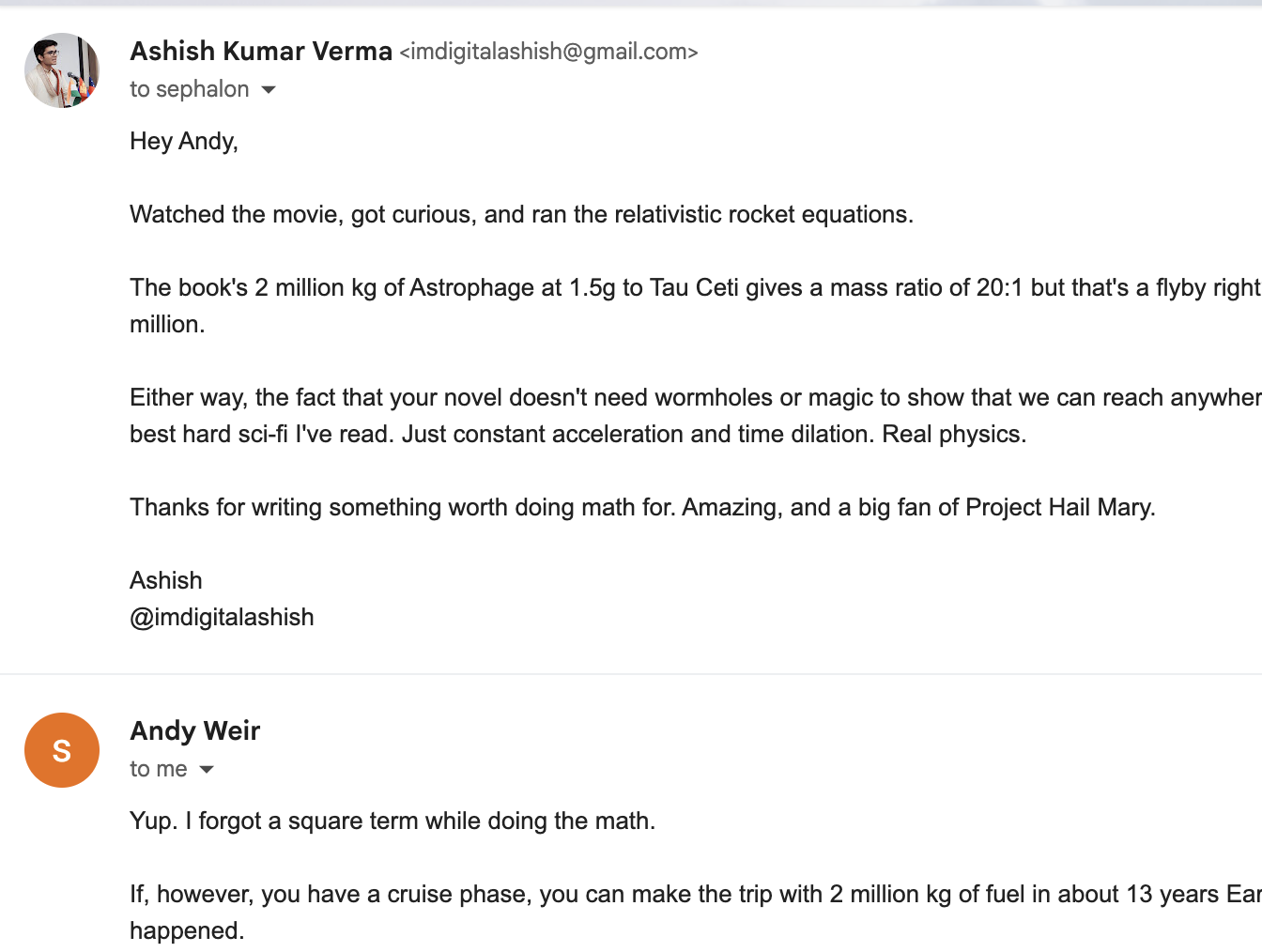
Andy Weir confirmed that the 2 million kg of Astrophage was only enough for a flyby. To actually stop at Tau Ceti you'd need to square that mass ratio, and he acknowledged it was an error. But then he said something interesting.
The coast phase. This is actually genius.
Weir said his fix was to add a coast phase, and honestly it's so simple it's beautiful. Instead of burning engines for the entire trip you do this: accelerate hard for a short burst, turn off the engines completely and just drift, then fire them again at the end to slow down. That middle part? Zero fuel. Free distance. You're just vibing through interstellar space with the engines off.
The tradeoff is time. You're not accelerating anymore so the trip takes longer, but the fuel savings are massive. I ran every coast percentage from 0 to 95%. Drag the slider:
⛵ Coast Phase Calculator
Drag the slider to see how coasting changes everything. At 85%, the book's numbers work perfectly.
At 85% coast something beautiful happens:
- Fuel needed: ~2 million kg ✅ matches the book
- Mass ratio: 20.7:1 ✅ matches the book
- Crew time: 6.6 years (longer than the "4 years" in the movie but survivable)
The book's numbers work perfectly if Grace was coasting for 85% of the trip. Basically accelerate for about 1 light year, drift for 10, decelerate for 1. The movie says "4 years 2 months 11 days" which maps to about 50% coast, and that still needs ~12 million kg of fuel. So the movie didn't fully fix it. But the novel? 85% coast. Everything checks out.
Why this book is different
Most sci-fi just handwaves the science. Wormholes here, warp drives there, some magic crystals because the plot needs it. Andy Weir actually sat down with the relativistic rocket equations and built a story around real physics. When the numbers were slightly off he had a real physics fix for it, not "oh the aliens have special technology" but just a coast phase. An actual engineering solution.
The fact that this novel survives a spreadsheet is insane. Not perfectly, but close enough that the fix is elegant and makes physical sense. Most stories don't survive a calculator. This one almost does, and honestly that's the highest compliment I know how to give.
The math for the nerds who stayed
Rapidity (relativistic "distance" in velocity space):
φ = acosh(1 + a·d / c²)
Peak velocity:
v = c · tanh(φ)
One way mass ratio (photon drive):
R = e^φ
Brachistochrone mass ratio (actually stopping):
R_total = R²
Time dilation factor:
γ = 1 / √(1 - v²/c²)
For a = 1.5g, d = 11.9 ly, ship = 100,000 kg:
- φ ≈ 3.03
- v ≈ 0.995c
- γ ≈ 10.2
- R (one way) ≈ 20.7
- R² (stop) ≈ 429
- Flyby fuel ≈ 2.0M kg ✅
- Stop fuel ≈ 42.8M kg
- Coast 85% fuel ≈ 2.0M kg ✅
~ Ashish Kumar Verma